


Irregular Preterite Verbs: Past Tense Spanish Made Simple


Get our free email course, Shortcut to Conversational.
Have conversations faster, understand people when they speak fast, and other tested tips to learn faster.
More infoIrregular preterite verbs tend to scare Spanish learners for one simple reason: they don’t seem to follow the rules. After spending time learning neat, predictable conjugation patterns, suddenly you’re expected to remember forms like tuve, hice, dije, and estuve.
But here’s the thing: not every irregular verb is completely irregular. Many belong to families that share the same stem changes or endings, so learning one helps you learn several others at the same time.
Let’s back up a bit about the most important Spanish past tenses.
In the indicative mood, there are two ways to speak about the past tense: the preterite (aka simple past) tense and the imperfect tense.
The Spanish preterite tense is used to describe actions completed at a specific point in the past; whereas the imperfect is used to describe habitual or continuous actions in the past with no specific beginning or end. For more on preterite vs imperfect tense, read here.
In this guide, you’ll learn the main groups of irregular preterite verbs, the patterns they follow, and the exceptions you’ll simply need to memorize.
How To Conjugate Irregular Preterite Verbs In Spanish
All verbs listed in the post can be considered irregular.
However, you’ll see that some verbs only require subtle changes, others undergo drastic spelling changes and some, quite frankly, do not abide by any rules whatsoever.
Although every verb in this guide is irregular, not all irregularities are equally difficult. Many verbs actually follow shared patterns, making them much easier to learn once you group them together.
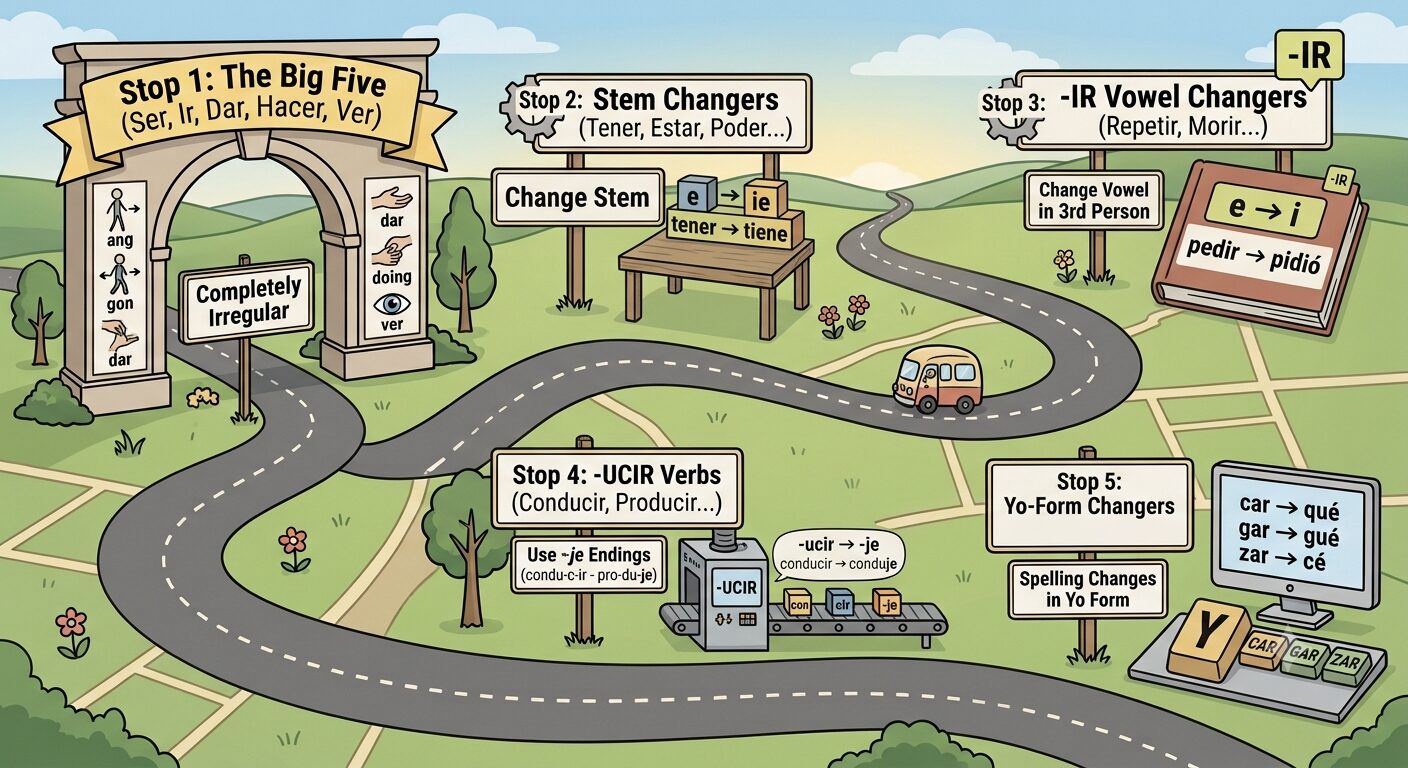
We’ll organize the most common irregular preterite verbs into five categories:
- Verbs that require significant changes: Ser, Ir, Dar, Hacer, Ver
- Verbs that require a stem change, but use regular endings
- Verbs ending in -ir that require a stem change
- Verbs ending in -ucir
- Verbs that are irregular in the “yo” form
1) Verbs that require significant changes
These are the most unpredictable irregular preterite verbs in Spanish. Unlike the other groups we’ll see later, these verbs don’t follow a shared pattern, so the best approach is simply to memorize their conjugations.
Fortunately, they’re also among the most common verbs in everyday Spanish, so you’ll encounter them constantly.
- Ser (to be)
- Ir (to go)
- Dar (to give)
- Hacer (to do)
- Ver (to see)
These five verbs are probably the most commonly used irregular verbs in the preterite, and so it’s important to memorize the conjugations by heart.
Let’s dive in.
| Subject | Verb: Ser (to be) | English Equivalent |
| Yo | fui | I was |
| Tú | fuiste | You were |
| Él/Ella/Usted | fue | He/She was |
| Nosotros/Nosotras | fuimos | We were |
| Ellos/Ellas/Ustedes | fueron | They were |
| Subject | Verb: Ir (to go) | English Equivalent |
| Yo | fui | I went |
| Tú | fuiste | You went |
| Él/Ella/Usted | fue | He/She went |
| Nosotros/Nosotras | fuimos | We went |
| Ellos/ellas/Ustedes | fueron | They went |
Sidenote:
One of the first things you’ll notice is that ser and ir share exactly the same preterite conjugations:
- fui
- fuiste
- fue
- fuimos
- fueron
So how do you know which verb is being used?
The answer is context. Ir usually describes movement or a destination, often followed by a” (or alternatively “para”) or another location. Ser, on the other hand, describes identity, characteristics, or states in the past.
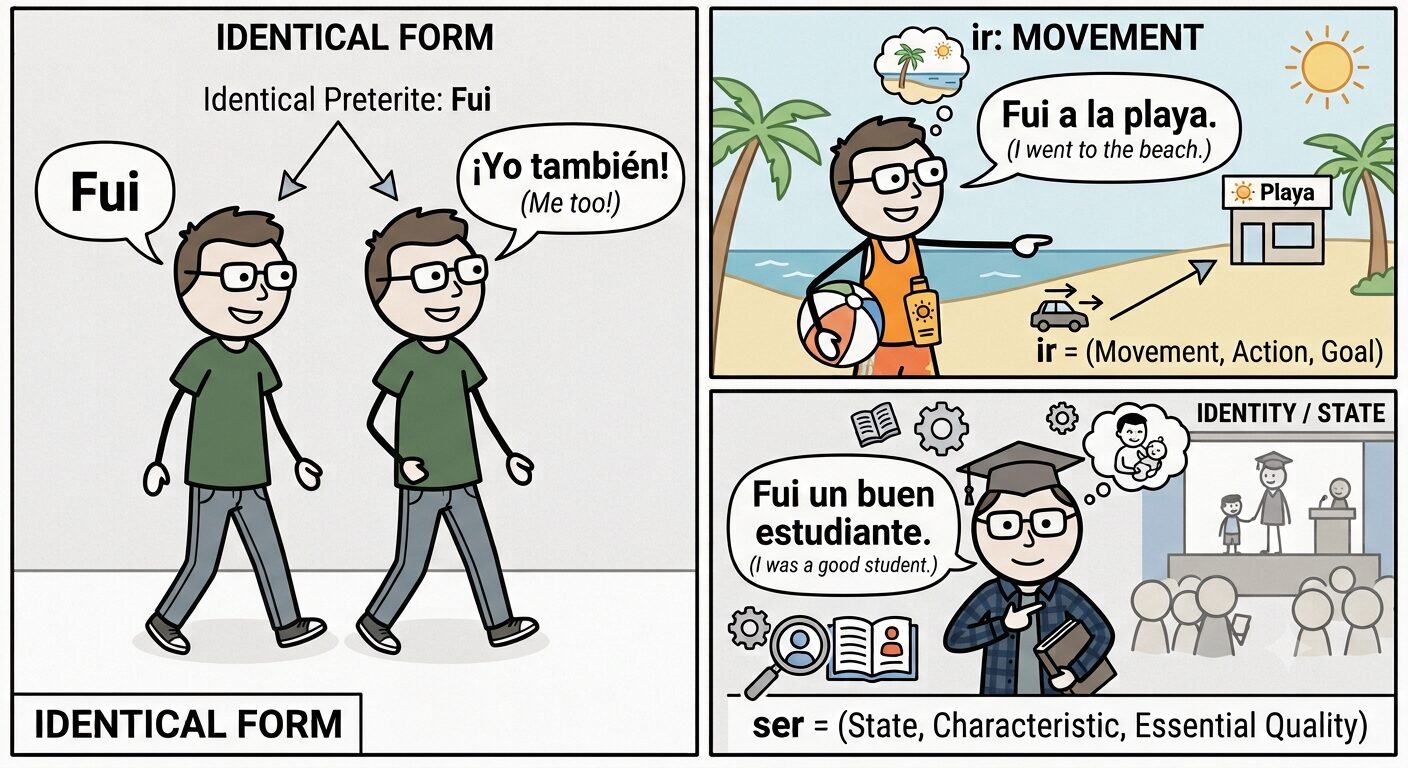
Let’s compare the two below.
- I went to see my neighbor – Fui a ver a mi vecino
- I was his neighbor for many years – Fui su vecino por muchos años
All clear?
Good. Let’s move on.
| Subject | Verb: Dar (to give) | English Equivalent |
| Yo | di | I gave |
| Tú | diste | You gave |
| Él/Ella/Usted | dio | He/She gave |
| Nosotros/Nosotras | dimos | We gave |
| Ellos/Ellas/Ustedes | dieron | They gave |
| Subject | Verb: Hacer (to do or to make) | English Equivalent |
| Yo | hice | I did |
| Tú | hiciste | You did |
| Él/Ella/Usted | hizo | He/She did |
| Nosotros/Nosotras | hicimos | We did |
| Ellos/Ellas/Ustedes | hicieron | They did |
| Subject | Verb: Ver (to see) | English Equivalent |
| Yo | vi | I saw |
| Tú | viste | You saw |
| Él/Ella/Usted | vio | He/She saw |
| Nosotros/Nosotras | vimos | We saw |
| Ellos/Ellas/Ustedes | vieron | They saw |
Moving on, we can look at stem changing verbs in the preterite.
The good news is that not every irregular verb is completely unpredictable. The next group follows a consistent pattern: although the stem changes, the endings remain the same for every verb in the group.
Once you memorize the endings, learning these irregular preterite verbs becomes much easier.
2) Irregular Preterite Verbs That Have Stem Changes, But Regular Endings
These irregular preterite verbs replace their normal stem with a new one but all share the same set of endings. Rather than memorizing every conjugation individually, you only need to learn each new stem and combine it with the common endings below.
| Subject | Verb Endings |
| Yo | -e |
| Tú | -iste |
| Él/Ella/Usted | -o |
| Nosotros/Nosotras | -imos |
| Ellos/Ellas/Ustedes | -ieron |
Once you learn these endings, simply add them to the new stem for the verb you wish to use.
| Verbs | Preterite Stem | English Equivalent |
| Andar | Anduv- | To walk |
| Caber | Cup- | To fit |
| Estar | Estuv- | To be |
| Haber | Hub- | To have |
| Poder | Pud- | Be able to |
| Poner | Pus- | To put |
| Querer | Quis- | To want |
| Saber | Sup- | To know |
| Tener | Tuv- | To have |
| Venir | Vin- | To come |
Once you’ve learned how to use these new stems, conjugating these irregular preterite verbs becomes much easier. Simply combine the stem with the irregular endings from the previous table:
- tener → tuv- → tuve, tuviste, tuvo, etc.
- poder → pud- → pude, pudiste, pudo, etc.
- venir → vin- → vine, viniste, vino, etc.
Rather than memorizing every conjugation individually, you only need to remember the stem change and apply the same set of endings each time.
Relatively straightforward, right?
3) Irregular Preterite Verbs Ending In -IR
Some -ir verbs undergo a second type of irregularity in the preterite. If they already have a stem change in the present tense, they usually keep a stem change in the preterite as well—but only in certain persons.
Unlike the present tense, these changes occur only in the third-person singular and plural (él/ella/usted and ellos/ellas/ustedes).
Before we elaborate on this, let’s review the endings for IR verbs in the preterite tense.
| Personal pronoun | -IR verb Ending |
| Yo | -í |
| Tú | -iste |
| Él/Ella/Usted | -ió |
| Nosotros | -imos |
| Ustedes/Ellos/Ellas | -ieron |
The above is quite straightforward.
Verbs ending in -IR that change stem in the simple present tense, will also change in the preterite, but only for the personal pronouns: él, ella, usted, ustedes, ellos, ellas.
The required stem change can be summarized into two groups, according to its changes:
| Changes in Preterite tense |
| From (e) – to (i) |
| From (o) – to (u) |
Let’s see some examples of these changes applied in the preterite tense.
| Personal pronoun | Repetir (To repeat) | Morir (To die) |
| e – i | o – u | |
| Yo | Repetí | Morí |
| Tú | Repetiste | Moriste |
| Él/Ella/Usted | Repitió | Murió |
| Nosotros | Repetimos | Morimos |
| Ustedes/Ellos/Ellas | Repitieron | Murieron |
Other verbs that require a similar change.
- To have fun – Divertirse
- To sleep – Dormir
- To lie – Mentir
- To ask for – Pedir
- To prefer – Preferir
- To feel – Sentir
- To suggest – Sugerir
- To wear/to get dressed – Vestir/se
4) Irregular Preterite Verbs Ending In -UCIR
Another important family of irregular preterite verbs includes verbs ending in -ucir, along with decir and traer. These verbs share the same distinctive -j- stem and use a unique set of endings. Meaning, words like conducir (to drive), producir (to produce), traducir (to translate), etc, plus the verbs traer (to bring) and decir (to say), have the following endings in the preterite:
| Subject | Verb Ending |
| Yo | -je |
| Tú | -jiste |
| Él/Ella/Usted | -jo |
| Nosotros/Nosotras | -jimos |
| Ellos/ellas/Ustedes | -jeron |
Let’s see the proper conjugation for the previously mentioned verbs :
| Subject | Verb: Traer (to bring) | English Equivalent |
| Yo | traje | I brought |
| Tú | trajiste | You brought |
| Él/Ella/Usted | trajo | He/She brought |
| Nosotros/Nosotras | trajimos | We brought |
| Ellos/Ellas/Ustedes | trajeron | They brought |
| Subject | Verb: Decir (to say) | English Equivalent |
| Yo | dije | I said |
| Tú | dijiste | You said |
| Él/Ella/Usted | dijo | He/She said |
| Nosotros/Nosotras | dijimos | We said |
| Ellos/Ellas/Ustedes | dijeron | They said |
Sidenote
The verb Decir keeps the same vowel change (e to i) from the simple present tense (decir to digo) in all the pronouns for all tenses (except the imperfect tense).
| Subject | Verb: Conducir (to drive) | English Equivalent |
| Yo | conduje | I drove |
| Tú | condujiste | You drove |
| Él/Ella/Usted | condujo | He/She drove |
| Nosotros/Nosotras | condujimos | We drove |
| Ellos/Ellas/Ustedes | condujeron | They drove |
| Subject | Verb: Producir (to produce) | English Equivalent |
| Yo | produje | I produced |
| Tú | produjiste | You produced |
| Él/Ella/Usted | produjo | He/She produced |
| Nosotros/Nosotras | produjimos | We produced |
| Ellos/Ellas/Ustedes | produjeron | They produced |
| Subject | Verb: Traducir (to translate) | English Equivalent |
| Yo | traduje | I translated |
| Tú | tradujiste | You translated |
| Él/Ella/Usted | tradujo | He/She translated |
| Nosotros/Nosotras | tradujimos | We translated |
| Ellos/Ellas/Ustedes | tradujeron | They translated |
Sidenote
Even though many third-person preterite forms end in -ió, verbs ending in -jo never take an accent.
- dijo
- trajo
- condujo
5) Verbs that are irregular in the “yo” form
Our final group isn’t irregular because of its endings, but because of its spelling.
These are called orthographic irregular verbs. The pronunciation stays exactly the same, but the spelling changes in the yo form to preserve the original sound.
There are three categories of verbs where this happens:
- Verbs ending in -car change c to qu
- Verbs ending in -gar change g to gu
- Verbs ending in -zar change z to c
- a) Verbs ending in -car change c to qu
Let’s see some examples.
| Subject | Verb: Tocar (to touch) | English Equivalent |
| Yo | toqué | I touched |
| Tú | tocaste | You touched |
| Él/Ella/Usted | tocó | He/She touched |
| Nosotros/Nosotras | tocamos | We touched |
| Ellos/Ellas/Ustedes | tocaron | They touched |
| Subject | Verb: Secar (to dry) | English Equivalent |
| Yo | sequé | I dried |
| Tú | secaste | You dried |
| Él/Ella/Usted | secó | He/She dried |
| Nosotros/Nosotras | secamos | We dried |
| Ellos/Ellas/Ustedes | secaron | They dried |
| Subject | Verb: Buscar (to look for) | English Equivalent |
| Yo | busqué | I looked for |
| Tú | buscaste | You looked for |
| Él/Ella/Usted | buscó | He/She looked for |
| Nosotros/Nosotras | buscamos | We looked for |
| Ellos/Ellas/Ustedes | buscaron | They looked for |
- B) Verbs ending in -gar change g to gu
| Subject | Verb: Regar (to water) | English Equivalent |
| Yo | regué | I watered |
| Tú | regaste | You watered |
| Él/Ella/Usted | regó | He/She watered |
| Nosotros/Nosotras | regamos | We watered |
| Ellos/Ellas/Ustedes | regaron | They watered |
| Subject | Verb: Pagar (to pay) | English Equivalent |
| Yo | pagué | I paid |
| Tú | pagaste | You paid |
| Él/Ella/Usted | pagó | He/She paid |
| Nosotros/Nosotras | pagamos | We paid |
| Ellos/Ellas/Ustedes | pagaron | They paid |
| Subject | Verb: Llegar (to arrive) | English Equivalent |
| Yo | llegué | I arrived |
| Tú | llegaste | You arrived |
| Él/Ella/Usted | llegó | He/She arrived |
| Nosotros/Nosotras | llegamos | We arrived |
| Ellos/Ellas/Ustedes | llegaron | They arrived |
- C) Verbs ending in -zar change z to c
| Subject | Verb: Cazar (to hunt) | English Equivalent |
| Yo | cacé | I hunted |
| Tú | cazaste | You hunted |
| Él/Ella/Usted | cazó | He/She hunted |
| Nosotros/Nosotras | cazamos | We hunted |
| Ellos/Ellas/Ustedes | cazaron | They hunted |
| Subject | Verb: Empezar (to start) | English Equivalent |
| Yo | empecé | I started |
| Tú | empezaste | You started |
| Él/Ella/Usted | empezó | He/She started |
| Nosotros/Nosotras | empezamos | We started |
| Ellos/Ellas/Ustedes | empezaron | They started |
| Subject | Verb: Rezar (to pray) | English Equivalent |
| Yo | recé | I prayed |
| Tú | rezaste | You prayed |
| Él/Ella/Usted | rezó | He/she prayed |
| Nosotros/Nosotras | rezamos | We prayed |
| Ellos/Ellas/Ustedes | rezaron | They prayed |
Final Thoughts on Irregular Preterite Verbs
The next time you come across a sentence like “Ayer tuve que salir temprano” or “Ella dijo que sí”, don’t worry if you can’t immediately explain why the verb looks different. Recognition comes before production. The more you expose yourself to Spanish through conversations, books, podcasts, or TV shows, the more these forms will start to feel familiar.
Eventually, you’ll stop thinking of tuve, hice, or trajeron as “irregular preterite verbs” and simply recognize them as the past tense forms of some of Spanish’s most common verbs. And that’s when you know they’re becoming part of your Spanish rather than just another grammar rule.
So don’t try to master all of them in one sitting: learn a few patterns, notice them when native speakers use them, and keep adding to your mental library.
You’ll be surprised how quickly they stop feeling irregular!
Irregular Preterite Verbs: Practice
Conjugate the verb into the correct Preterite form
- El año pasado mi hermana y yo (ir) ____ a Chile
- La semana pasada mi esposa (cocinar) ____ una pasta deliciosa con albóndigas
- Mi hermano (ser) ____ un buen estudiante. Siempre sacaba buenas notas en las pruebas de Matemáticas
- Mis padres (tener) ____ abandonar sus estudios, porque eran muy costosos
- Mi familia no (traer) ____ nada de comida o pasapalos a la fiesta pasada de cumpleaños.
- La película (comenzar) hace media hora. (Llegar) (Tú) ____ muy tarde
- Al fin (encontrar) (yo) ____ mis llaves. Las había dejado dentro de la gaveta de la cocina
- Ella me (pedir) ____ un carro nuevo la Navidad pasada. Desafortunadamente no (poder) (yo) ____ comprarlo porque no tenía dinero suficiente
- Karla no (traducir) el documento completo, es por eso que ahora tiene mucho más trabajo por hacer.
- Hace dos años mi familia y yo (viajar) a Estados Unidos de vacaciones. (Ser) ___ un viaje genial.
Answers
- El año pasado mi hermana y yo fuimos a Chile
- La semana pasada mi esposa cocinó una pasta deliciosa con albóndigas
- Mi hermano fue un buen estudiante. Siempre sacaba buenas notas en las pruebas de Matemáticas
- Mis padres tuvieron que abandonar sus estudios, porque eran muy costosos
- Mi familia no trajo nada de comida o pasapalos a la fiesta pasada de cumpleaños
- La película comenzó hace media hora. Llegaste muy tarde
- Al fin encontré mis llaves. Las había dejado dentro de la gaveta de la cocina.
- Ella me pidió un carro nuevo la navidad pasada. Desafortunadamente no pude comprarlo porque no tenía dinero suficiente.
- Karla no tradujo el documento completo, es por eso que ahora tiene mucho más trabajo por hacer.
- Hace dos años mi familia y yo viajamos a Estados Unidos de vacaciones. Fue un viaje genial.