


Present Perfect Subjunctive in Spanish: How to Use Haya, Hayas, Hayamos

Get our free email course, Shortcut to Conversational.
Have conversations faster, understand people when they speak fast, and other tested tips to learn faster.
More infoThe present perfect subjunctive in Spanish is used to talk about actions that have already happened, but are still connected to feelings, doubt, possibility, or expectations.
If that sounds complicated, don’t worry. The structure is actually very simple!
The formula is:
haber (present subjunctive) + past participle
For example:
- Me alegra que hayamos hablado. – I’m glad that we have talked.
- Es posible que hayan llegado tarde. – It’s possible that they arrived late.
In this guide, you’ll learn:
- How to conjugate the present perfect subjunctive
- When to use it in real conversations
- Clear examples you can start using right away
Let’s start!
What is the present perfect subjunctive in Spanish?
As you probably know by now, the subjunctive is a mood, not a tense. But what does this mean for the present perfect subjunctive?
In general, the subjunctive is used to frame statements that include some degree of uncertainty. The present perfect subjunctive mood is specifically used to speak about past actions that are connected to the present, as well as future actions that may or may not be completed.
The reason this specific subjunctive form causes confusion is mostly due to the fact that it doesn’t have a direct English equivalent. This means some sentences sound a bit strange when we try to translate them literally.
For example:
- Me alegra que hayamos hablado antes de que te vayas –. I’m glad that we have talked before you leave.
- Espero que hayas tenido un buen día. – I hope you had a good day.
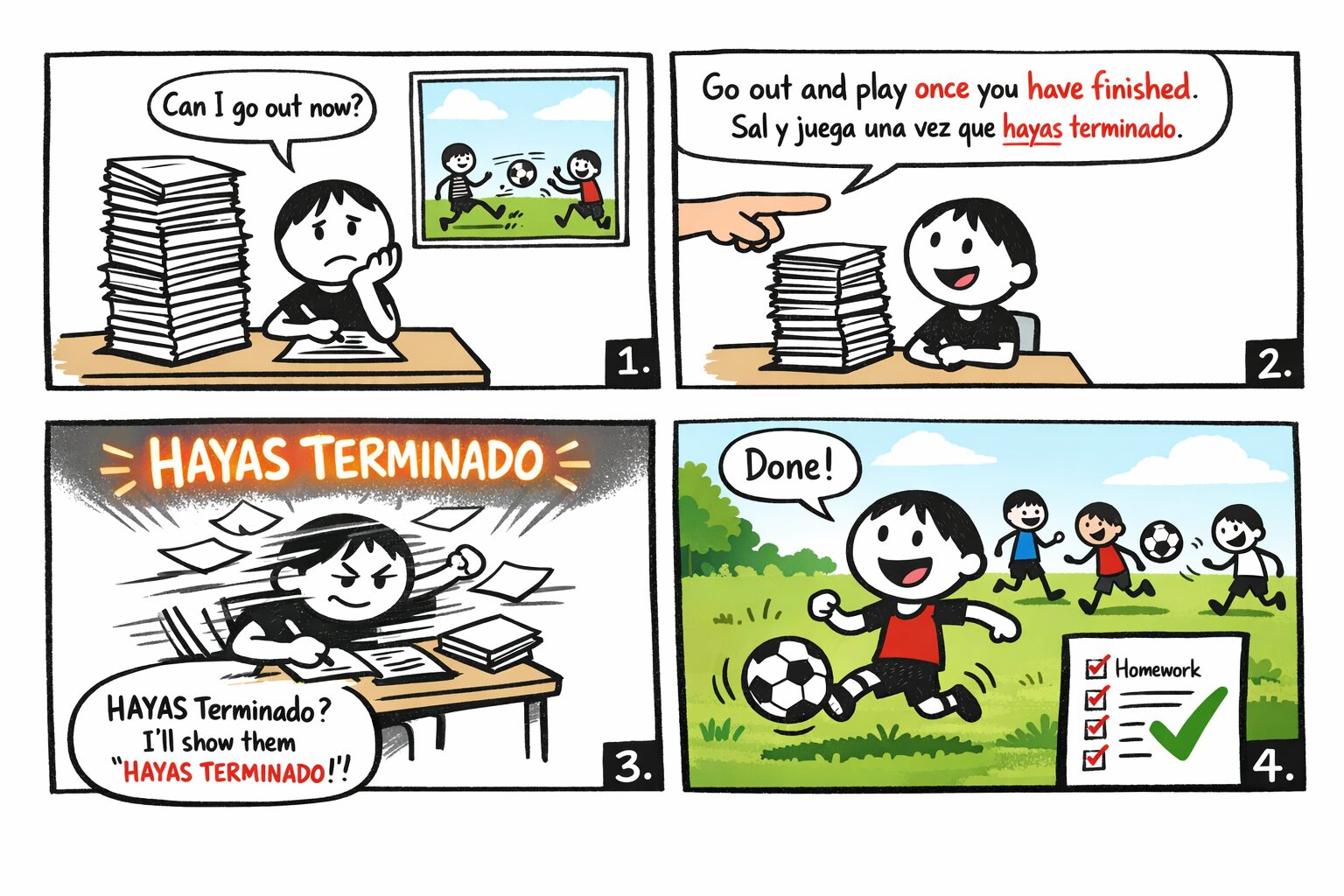
- Sal y juega una vez que hayas terminado tu tarea. – Go out and play once you have finished your homework.
Don’t worry, we’ll go into more detail on this later on. For now, let’s review how to conjugate verbs for this case.
Conjugate Haber in the Present Subjunctive
Every Spanish perfect tense uses the auxiliary verb haber.
For example, if you already studied the Spanish present perfect, then you’ll remember that its conjugation requires a simple formula:
- Auxiliary verb “haber” (present tense) + past participle of the action verb.
The present perfect subjunctive requires a similar formula:
- Auxiliary verb “haber” (present subjunctive) + past participle of the action verb.
As you can see, the only difference is that the auxiliary verb “haber” is conjugated in its present subjunctive, rather than in the present tense.
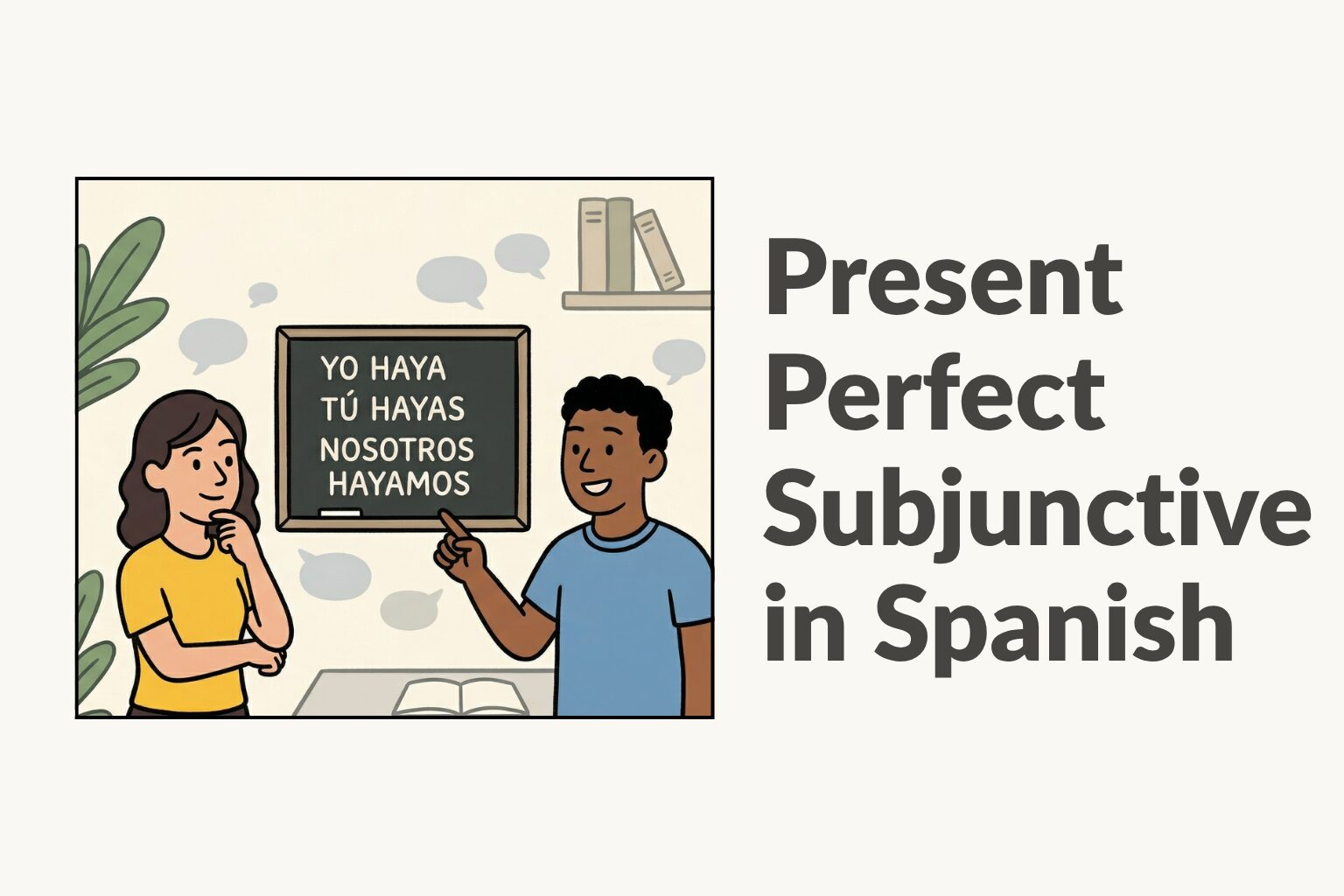
| Personal pronoun | Verb Haber (Present Subjunctive) |
| Yo | Haya |
| Tú | Hayas |
| Él / Ella | Haya |
| Usted | Haya |
| Nosotros | Hayamos |
| Ustedes | Hayan |
| Ellos / Ellas | Hayan |
How to find the past participle
Once you know that “haber” is conjugated differently, all you need to do is add the past participle of the action verb.
For all regular -AR verbs, we use the ending -ado as follows:
| English Infinitive | Spanish Infinitive | English Past Participle | Spanish Past Participle |
| To buy | Comprar | Bought | Comprado |
| To close | Cerrar | Closed | Cerrado |
| To cut | Cortar | Cut | Cortado |
As for all regular verbs that end in -ER and -IR, we use the ending -ido at the end of the conjugation:
| English Infinitive | Spanish Infinitive | English Past Participle | Spanish Past Participle |
| To Eat | Comer | Eaten | Comido |
| To know | Conocer | Known | Conocido |
| To sleep | Dormir | Slept | Dormido |
| To hear | Oír | Heard | Oído |
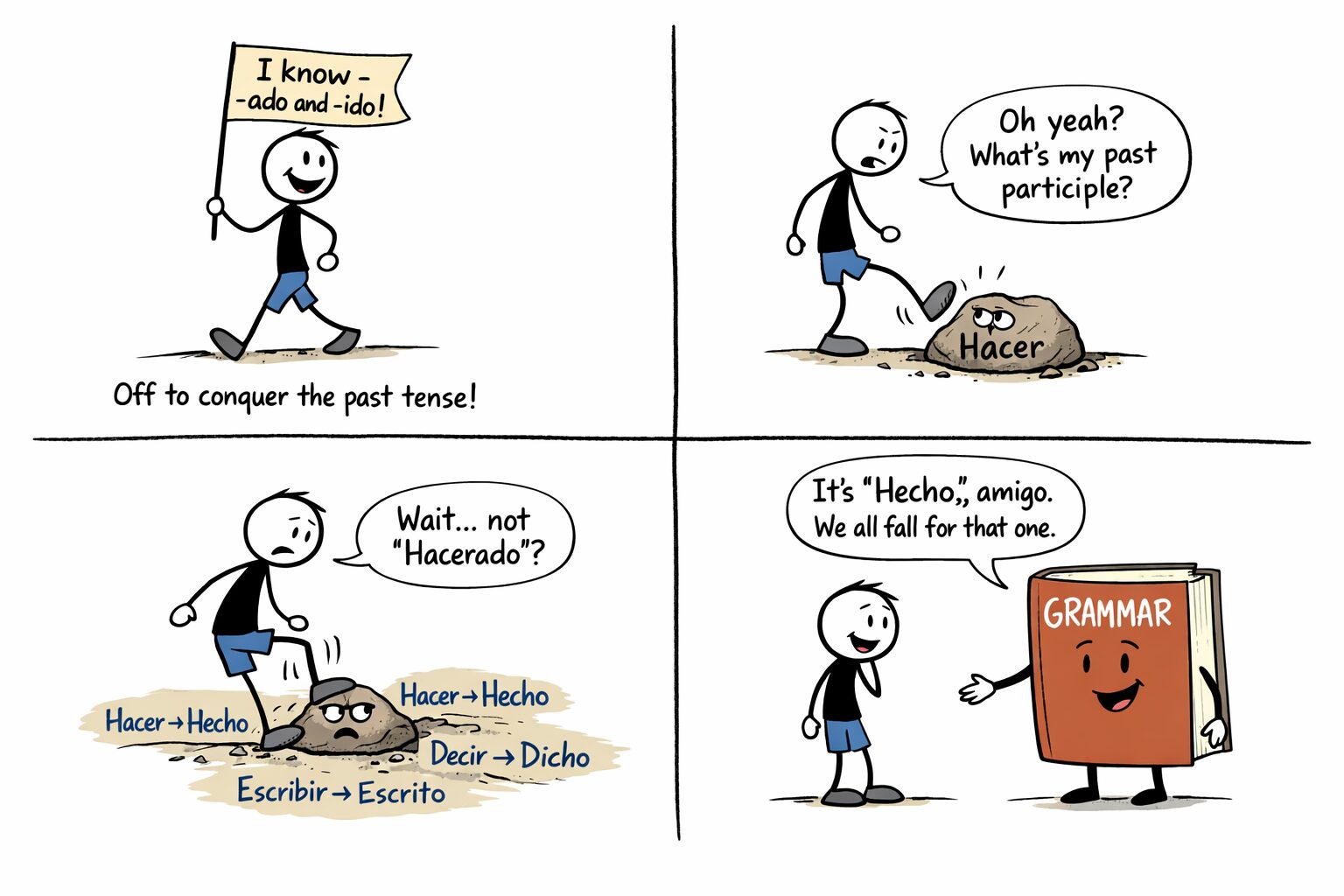
Note: As always, there are some irregular verbs (like ver → visto, hacer→ hecho, decir → dicho). You can read about those specific verbs in our guide to past participles)
When To Use Present Perfect Subjunctive in Spanish
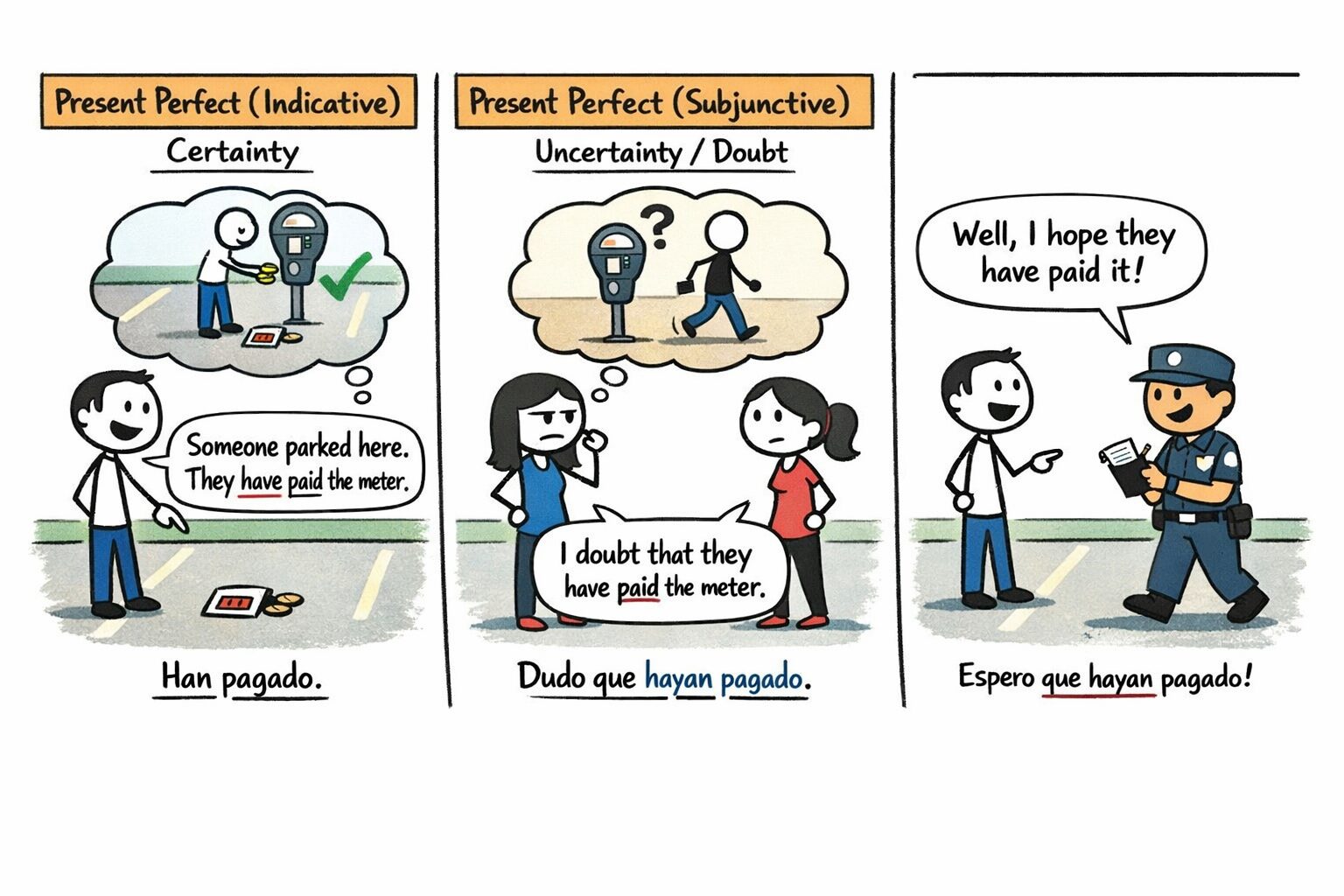
The present perfect subjunctive appears when we talk about past actions connected to uncertainty, emotion, or expectation.
Here are the most common situations:
Opinions
- No creo que haya sido verdad. – I don’t think it has been true.
- Dudo que haya viajado tanto. – I doubt that he has traveled that much.
Things that are likely to happen
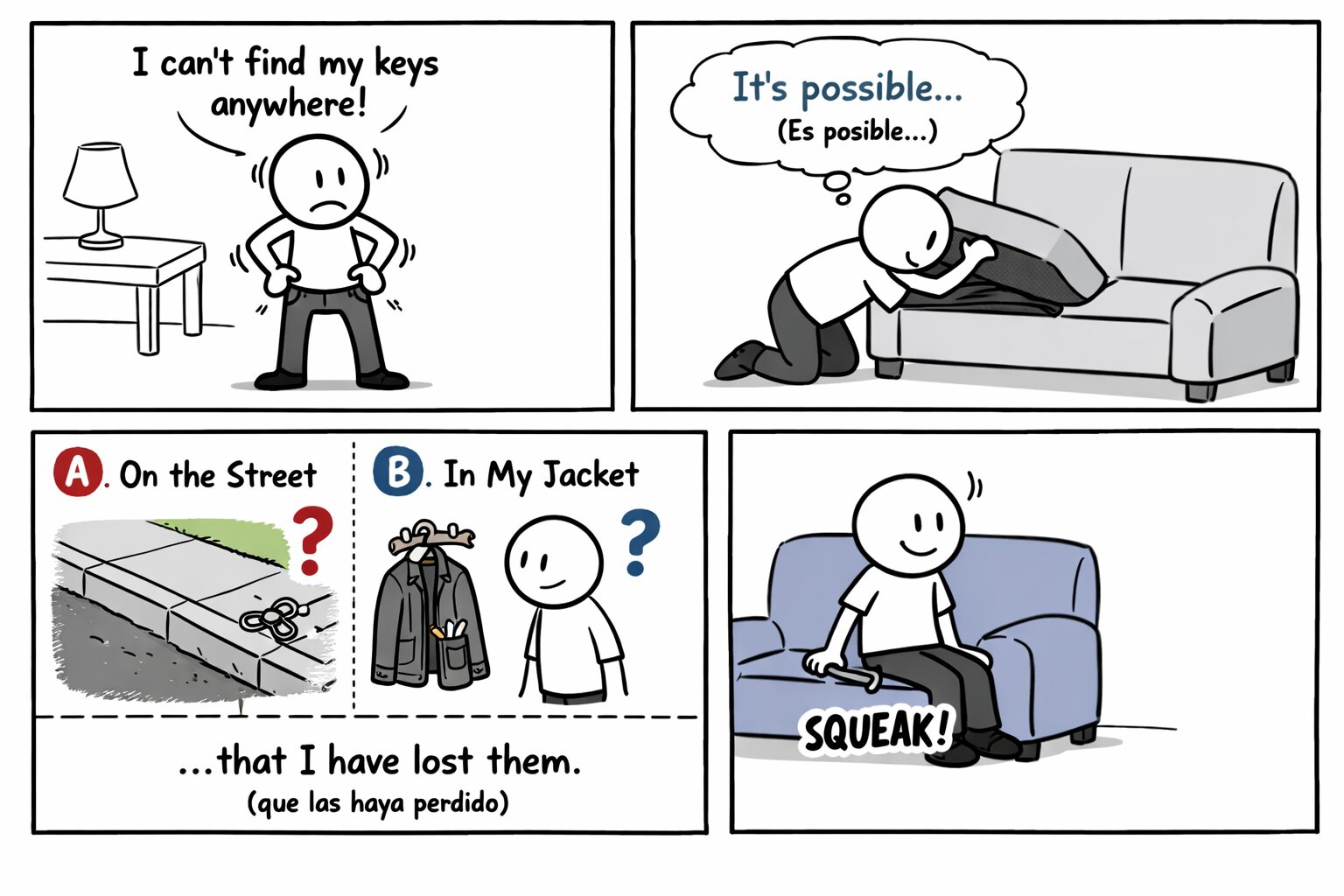
- Es posible que hayan llegado tarde hoy. – It is possible that they’ve arrived late today.
- Es posible que esos turistas hayan estado en la playa esta mañana porque están muy bronceados. – It is possible that those tourists have been on the beach this morning because they are really tanned.
Wishes and expectations
- Espero que hayas tenido un buen día. – I hope you’ve had a good day.
- Espero que te haya gustado el regalo. – I hope you liked the gift.
Past Actions related to the present
Used when something may have happened, but we are not sure, ie., we are talking about a possibility.
For example:
- Es posible que haya perdido todo mi dinero – It’s possible that I’ve lost all my money.
- Es posible que hayan encontrado un buen restaurante. – It is possible that they’ve found a good restaurant.
- Espero que el equipo de fútbol haya ganado el partido. – I hope that the soccer team won the match.
Future actions that may or may not be completed
In other words, you can use the Present Perfect Subjunctive Spanish to describe actions that we expect to be finished in the future.
Take a look at these examples:
- Deseo que para el próximo año ya hayamos vendido la casa. – I hope that we’ve already sold the house by next year.
- Llama a tu madre cuando hayas terminado la tarea, – Call your mother when you’ve finished the homework.
(sidenote: We wrote an overview of all six Spanish subjunctive forms here)
And there you have it: the present perfect subjunctive is no longer a mystery. By understanding the simple formula of haya + past participle, you’ve added a powerful tool to your Spanish toolkit. You can now navigate those gray areas of conversation with confidence.
The real magic happens when you start listening for it. Pay attention to native speakers in movies or music; you’ll be surprised how often this structure pops up now that you know what to look for. So go ahead, practice the examples, and don’t be afraid to use haya in your next conversation. Spanish speakers will appreciate the effort, and you’ll sound more natural than ever.
¿Tienes ganas de más? Browse our other grammar guides!
Practice: Present Perfect Subjunctive Spanish
Complete the sentences by conjugating haber + the past participle in the present perfect subjunctive.
(scroll to the bottom for the answers)
1.Haber / Terminar
Dime cuando _____ _____ de cocinar (Tell me when you have finished cooking)
2.Haber / Limpiar
Podremos salir, cuando _____ _____ nuestra habitación (We can go out when we have cleaned our room)
3.Haber / Salir
Ojalá todo _____ _____ bien en su cita a ciegas (I hope everything went well in his blind date)
4.Haber / Comprar
No creo que ella _____ _____ un carro nuevo (I don’t think she bought a new car)
5.Haber / Tener
Espero que _____ _____ una hermosa luna de miel (I hope you had a beautiful honeymoon)
6.Haber / Salir
Podrán ver al paciente cuando el _____ _____ de quirófano (You will be able to see the patient when he has left the operating room)
7.Haber / Poner
Es bueno que te _____ _____ una chaqueta porque hace frío (It’s good that you put on a jacket because it’s cold)
8.Haber / Ver
Dudo que _____ _____ un unicornio (I doubt you’ve seen a unicorn)
9.Haber / Terminar
Cuando _____ _____ de leer este libro, voy a comprar otro (When I have finished reading this book, I will buy another one)
10.Haber / Oír
Tal vez ella _____ _____ lo que dijiste (Maybe she heard what you said)
Answers
1.Dime cuando hayas terminado de cocinar
2.Podremos salir, cuando hayamos limpiado nuestra habitación
3.Ojalá todo haya salido bien en su cita
4.No creo que haya comprado un carro nuevo
5.Espero que hayan tenido una hermosa luna de miel
6.Podrán ver al paciente cuando haya salido de quirófano
7.Es bueno que te hayas puesto una chaqueta porque hace frío
8.Dudo que hayas visto un unicornio
9.Cuando haya terminado de leer este libro, voy a comprar otro
10.Tal vez ella haya oído lo que dijiste