


Introducing: Real World 2.0 curriculum

Get our free email course, Shortcut to Conversational.
Have conversations faster, understand people when they speak fast, and other tested tips to learn faster.
More infoOn November 24th, 2026, Real World is getting its biggest upgrade in years.
We’ve listened to student feedback over the years, and it’s clear most of you want two things:
- One curriculum to follow, with everything in one place.
- A better way to track your progress along the way.
So we spent months restructuring the Real World curriculum and adding new features we think you’ll love.
Here are the five big changes.
#1 Goodbye Electives, Hello Conversation Practice
This is the big one.
We’re replacing Electives with dedicated Conversation Practice Lessons.
The idea is simple.
- Core Lessons help you build the foundations, like grammar and vocabulary.
- Conversation Practice gives you the speaking reps to make it stick.
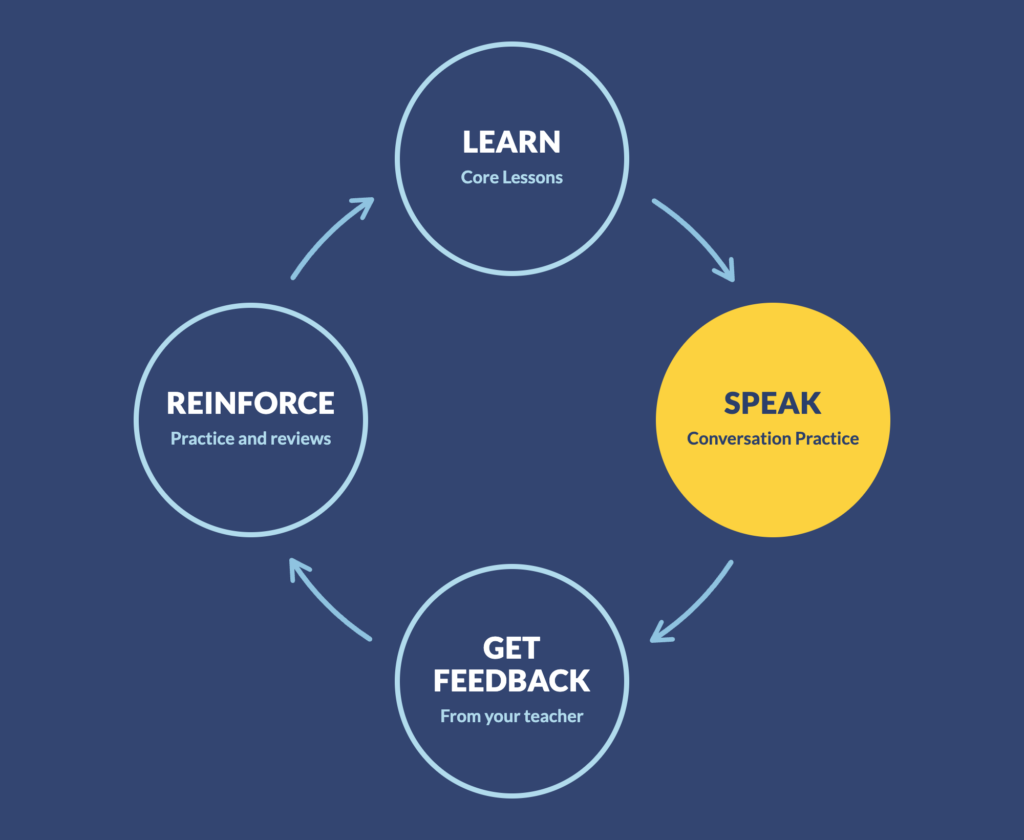
Conversation Practice Lessons are structured, and built around what you’ve just covered in your Core Lessons. They help you take the Spanish you know in your head and use it out loud, with activities like role-plays, storytelling, and real-life situations.
Here’s how it works as you move through the levels:
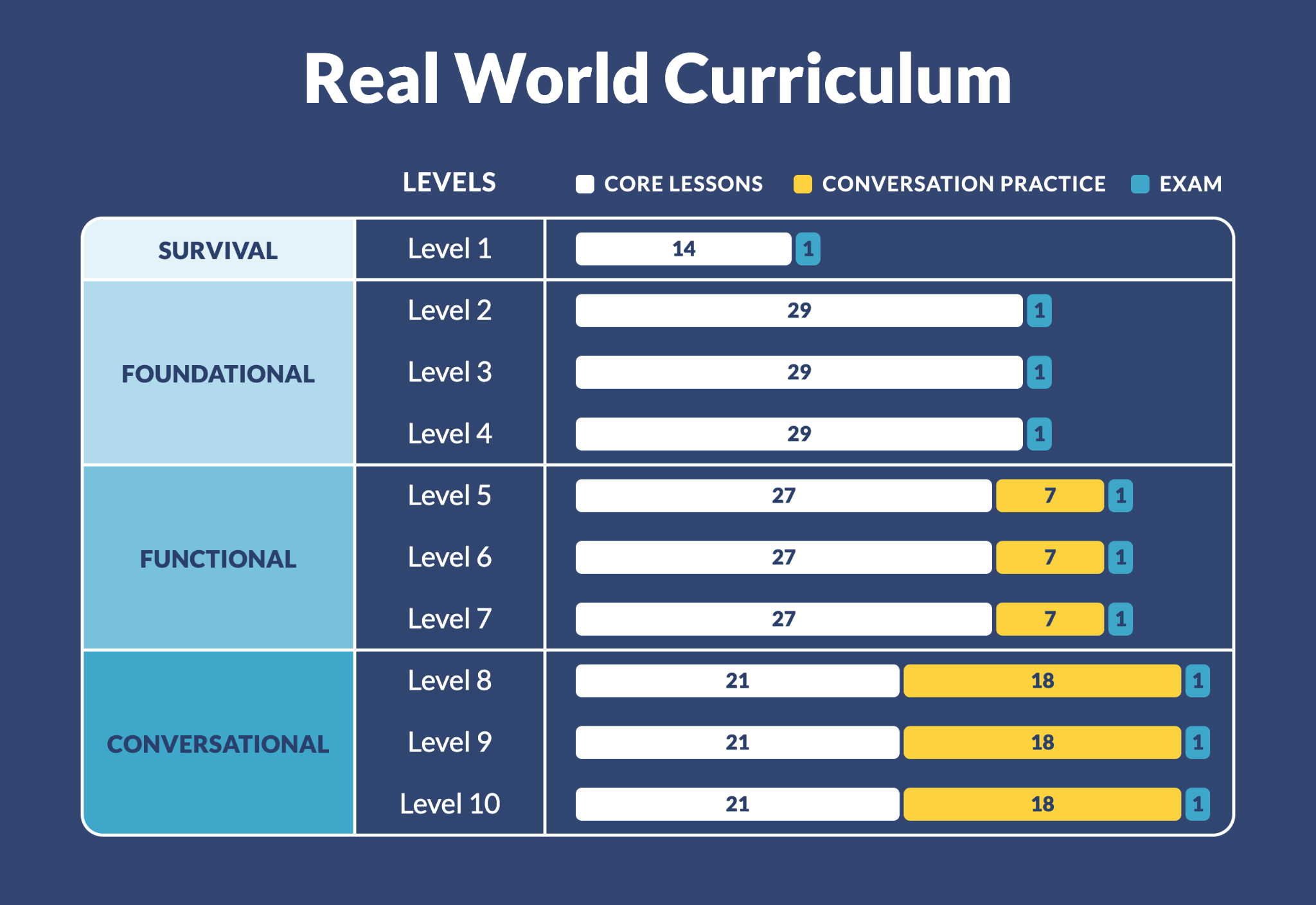
Levels 1 to 4: Core Lessons only.
You’ll mostly focus grammar, vocab and pronunciation in order to have strong foundations. Conversation Practice starts at Level 5, once you have enough Spanish to work with.
Levels 5 to 7: Core Lessons, plus 7 Conversation Practice Lessons per level.
You’ll spend time practicing conversations about everyday life, like planning a trip, shopping in the city, or talking about when you were a kid. Each lesson has a set topic and comes every few lessons, so you use what you’ve just covered while it’s fresh.
Levels 8 to 10: Core Lessons, plus 18 Conversation Practice Lessons per level.
This is where the Conversation Practice lessons go deeper. You’ll move from speaking about everyday situations to more open conversations where you will share opinions, debate ideas, and tell stories.
At this level, there are always two conversation topics to choose from.
- Hispanic Culture: one Spanish-speaking country at a time. Think Argentina’s asado, Colombia’s music from vallenato to reggaeton, or Costa Rica’s “pura vida”.
- General Culture: the same theme, worldwide. Think street food, whether the algorithm picks our music for us, or what the world’s happiest countries have in common.
You only need to complete one for the lesson to count, but you’re welcome to do both.
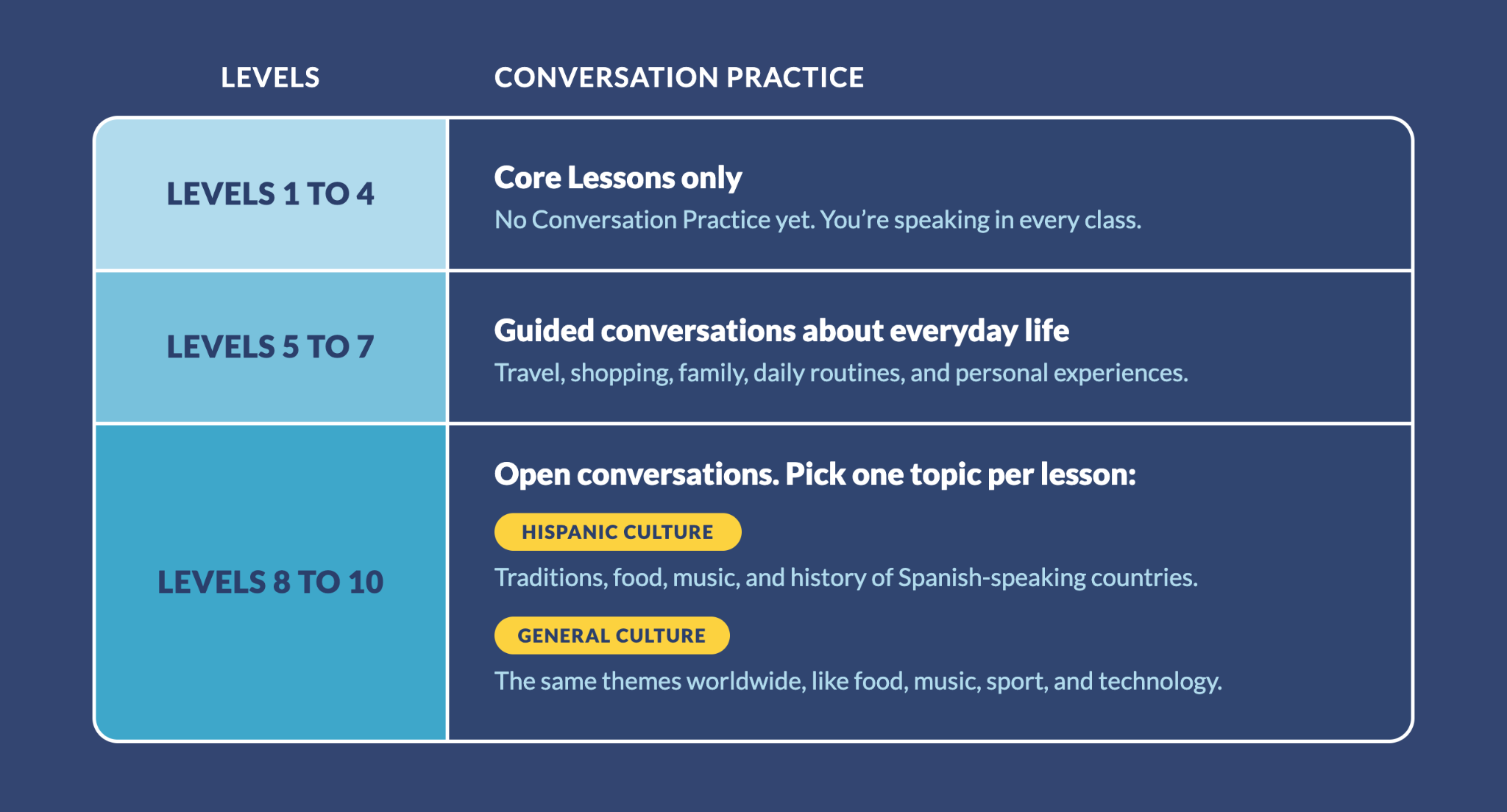
If you’re following our progression system and want to move up through the levels, Conversation Practice is required from Level 5.
Following the progression system is optional. But we recommend it, so you get your speaking reps in.
Even though Electives no longer count toward the progress system, you’re still free to use them with your teacher. You’ll find them under Extra Resources.
#2: One Clear Path, From Level 1 to Level 10
Levels used to run from 0 to 9, which was confusing for some students. We felt like this was the perfect opportunity to restructure.
Real World levels now run from 1 to 10.
That means if you’re a current student, your level number will automatically get bumped up by one. If you were Level 4, you’re now Level 5. Your actual progress doesn’t change. You’re in exactly the same place, just with a new number.
The 10 levels are now grouped into four stages:
- Survival (Level 1)
- Foundational (Levels 2 to 4)
- Functional (Levels 5 to 7)
- Conversational (Levels 8 to 10)
#3: Written Feedback From Your Teachers
Until now, the only feedback you heard from teachers was perhaps at the end of a class.
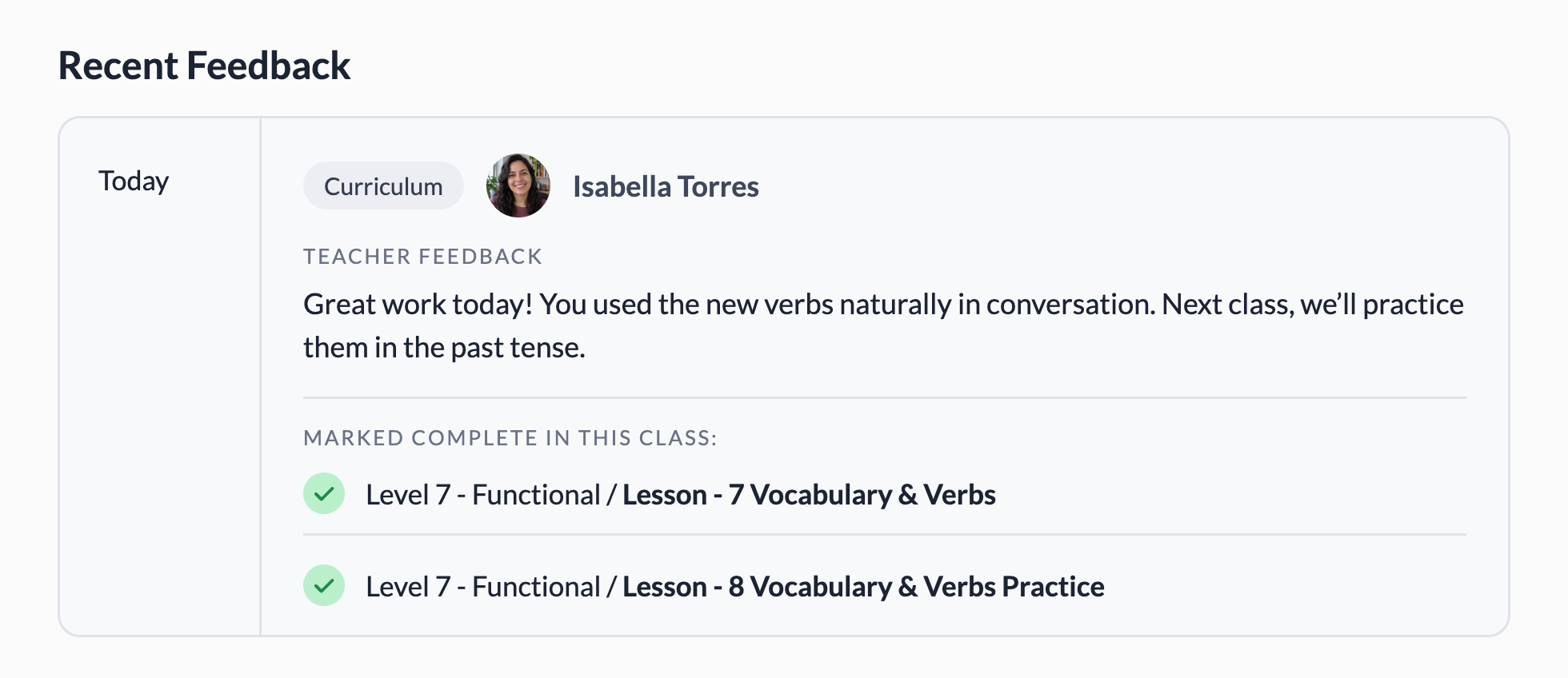
With this update, your teachers will leave you written feedback after each class, so you better under how you’re progressing.
You’ll find this feedback in the My Progress section and it will help you understand:
- What you worked on.
- Where you’re making progress.
- What needs more practice.
- What your teacher recommends focusing on next.
#4: Improved Progress Tracking
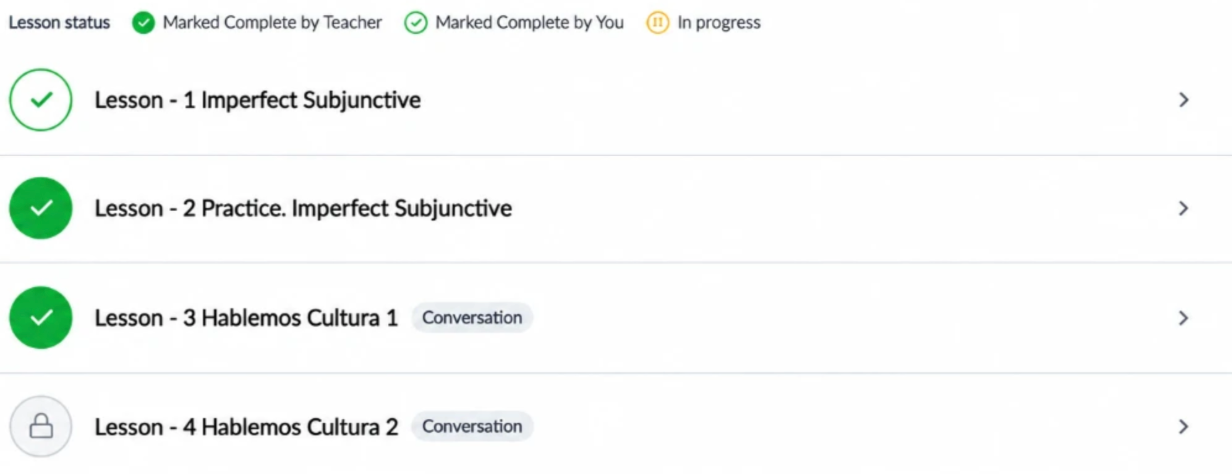
In the past, only you could mark lessons as complete.
Even though teachers tracked your progress too, it was behind the scenes, where you couldn’t see it.
Now it’s all in one place.
There are two ways a lesson gets ticked off:
- In class: when you finish a lesson with a teacher, your teacher marks it complete.
- On your own: if you studied a lesson yourself, or already know the material, you can mark it complete.
Both count toward your progress in exactly the same way. The label just shows how the lesson was completed, so you and your teachers can tell at a glance what you’ve covered in class and what you’ve done on your own.
We recommend doing every lesson with a teacher. But we know that there are times when you already know a lesson and don’t need a teacher to take you through it.
The only things you can’t mark done yourself are Conversation Practice Lessons and Level Exams.
Those have to be marked as done by a teacher.
Finally, if your class ends while you’re in the middle of a lesson, your teacher will mark it In Progress, so you and your next teacher know where to pick up.
#5: How The Progression System Now Works
With Electives out of the picture, we’re keeping this simple.
- Levels 1 to 4: go through the lessons and pass the Level Exam with a teacher.
- Levels 5 to 10: go through the lessons, including the Conversation Practice requirements, and then pass the Level Exam with a teacher.
So why are Conversation Practice lessons mandatory?
We know that students join BaseLang because they want to speak Spanish, not just study it.
Plenty of methods teach Spanish, but leave you unable to hold a conversation. That’s exactly what we want to avoid.
So from Level 5, we’ve built dedicated speaking reps into every level.
Think of BaseLang as a gym for your Spanish. Every speaking rep makes you a little stronger, until speaking Spanish feels natural.
What Happens to Your Progress
This update doesn’t mean starting over.
Before we launch the update, we’ll take a snapshot of where you are in the curriculum and move you to the equivalent level, with your completed lessons carried over.
In your first class after the update, you and your teacher will go through where you are and check that nothing was missed.
We’ll do our best to capture everything, but this is a massive update behind the scenes.
If something looks off, tell your teacher or message us in the support chat and we’ll fix it.
We’re also keeping your old progress records as a backup, so nothing is lost.
One Last Thing: You’re Still in Charge
There’s no obligation to strictly follow the curriculum. There never has been.
At BaseLang, you can do whatever you want in your classes, and that hasn’t changed.
We do think the curriculum is the fastest way to reach conversational Spanish, so that’s what we recommend. But everyone is different, so feel free to experiment.
The most important thing is that you enjoy the process and have fun in your classes.
When the update arrives.
Once the update drops, feel free to explore the new system.
- Open the Lessons page to explore the new curriculum and see your completed lessons.
- Visit My Progress to check your level. The teacher feedback section will be empty until you’ve taken your first couple of classes under the new system.
- In your next class, your teacher will help you find your place and choose what to work on next.
You’ll also find a Getting Started guide inside Lessons – Real World.
FAQ
Why did you replace Electives?
With hundreds of Elective lessons to choose from, many students felt overwhelmed.
It was hard to know what to pick, or how any of them connected to what you’d just learned in your Core Lessons.
Now everything is connected.
Conversation Practice Lessons are built into each level and linked to what you’ve covered in your Core Lessons, so you’re practicing what you’ve just learned.
What happens to my completed Electives?
You keep the level they helped you reach, and everything below it is marked complete. Going forward, Electives don’t count toward moving up.
From Level 5, you’ll do Conversation Practice Lessons instead.
Why can’t I still use Electives as part of the progression system?
With 300 teachers, we need everyone working from one system. Running two sets of requirements side by side would make your progress harder to track and less consistent from one teacher to the next.
We also believe Conversation Practice will get you better results, faster. And if you like Electives, you can still use them in class any time. They just don’t count toward moving up a level.
What are Conversation Practice Lessons?
These are dedicated lessons that help you put your Spanish into use through guided conversations, role plays, storytelling, discussions, and other speaking activities.
They’re part of the core curriculum from Level 5 onward and must be completed with a teacher to advance officially.
How many Conversation Practice Lessons do I need to complete?
- Levels 5–7: 7 lessons per level.
- Levels 8–10: 18 lessons per level.
You’ll find them within each level’s Core Lessons.
Do I need to prepare before a Conversation Practice Lesson?
No preparation is required. The lessons are designed for you and your teacher to review the resources together during class.
Wait, Real World has 10 levels now?
It always had 10. They used to be numbered 0 to 9, but now they will run from 1 to 10.
What happens to my completed lessons?
You won’t be starting over. We’ll move you to the equivalent level in the new curriculum, with your completed lessons carried over. In your first class after the update, your teacher will go through it with you and check nothing was missed.
We did some restructuring along the way, so some lessons might have moved
Why do some lessons look different or sit in a different place?
We did some restructuring along the way. Some lessons moved, some were combined, and some were updated, so a topic you know might now have a new name or sit at a different level.
Your progress isn’t affected. Lessons you’ve already completed are matched to their new equivalents.
Why don’t I see all my past classes in My Progress?
All your progress carries over: your level and every lesson you’ve completed.
The class history in My Progress is a new feature, so it starts with your three most recent classes. That’s enough for you and your teachers to pick up where you left off, and it will fill up as you take more classes.
Can I still mark lessons as complete myself?
Yes, for regular lessons that allow it. You can mark them complete after studying independently or if you already know the material.
Conversation Practice Lessons and Level Exams require a teacher and cannot be completed through self-marking.
What is the Mid-Level Quiz? Is it required?
The Mid-Level Quiz is an optional check of your understanding of the first half of a level. It helps identify topics you may want to review before continuing.
You can take it independently or with a teacher. You don’t need to pass it to continue studying or take your Level Exam. Mid-Level Reviews and Quizzes begin at Level 2.
—
If you have any questions about this update, just open the Live Chat to speak to one of our agents, or email us at support@baselang.com.